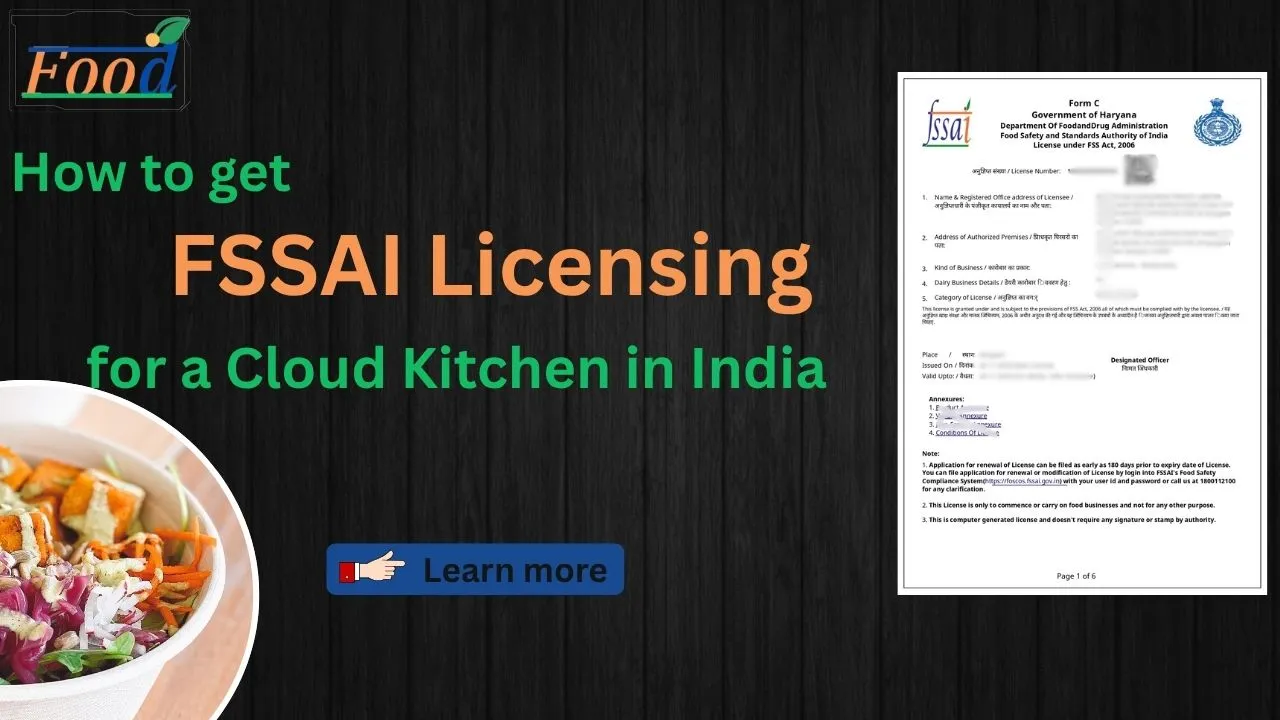
India's food delivery market is growing fast, and cloud kitchens are at the centre of it. No dine-in. No storefront. Just a commercial kitchen, a delivery platform, and hungry customers. But here is what many new cloud kitchen owners miss — preparing and selling food without a valid FSSAI license is illegal in India. It does not matter whether customers walk in or not. The moment food is prepared and sold, FSSAI registration is required. This guide covers everything you need — which license to apply for, what documents to keep ready, how the process works, and what it costs.
What is a Cloud Kitchen — and Does It Need an FSSAI License?
A cloud kitchen, ghost kitchen or dark kitchen is a commercial kitchen that is used for the preparation of food orders for delivery. The food is cooked in a commercial kitchen and delivered to customers through third-party platforms such as Swiggy, Zomato or through direct online orders.
As per the Food Safety and Standards (FSS) Act of 2006, an FBO is any person who carries on the business of catering to the mass food needs, living food service providers or food providers/ manufacturers in India. Cloud kitchens fall squarely in this category.
What Happens if a Cloud Kitchen Operates Without an FSSAI License?
Operating without a valid FSSAI food license puts your entire business at risk:
Getting the license before launching is far simpler than handling the consequences after an inspection.
Which FSSAI License Does a Cloud Kitchen Need?
The right FSSAI license type depends on your annual turnover and scale of operations.
Most cloud kitchens launching today need a State License. If you are operating from a single city or state with moderate turnover, this is your category.
If your cloud kitchen group operates across multiple states — or if your turnover is expected to cross ₹20 crores — a Central License is required from day one.
Documents Required for an FSSAI License
Essential Papers for FSSAI License In Case Of Cloud Kitchen Holding the documents before making an application will save the trouble of getting an application resubmitted or getting your application rejected. Here's all about them:
For FSSAI Basic Registration
- 1 Photo ID proof — Aadhaar card, Voter ID or Passport
- 2 Proof of address of kitchen — electricity bill or rent agreement
- 3 A recent passport-sized photograph of the applicant
For FSSAI State or Central License
- 1 PAN card of the business or applicant
- 2 GST registration certificate (if applicable)
- 3 Rent agreement or NOC from the property owner for the kitchen premises
- 4 Kitchen layout or floor plan — showing preparation, storage, and packaging areas
- 5 Complete list of food products to be prepared and sold
- 6 Water testing report — from a government-approved laboratory
- 7 NOC from the local municipality or Panchayat (where required)
- 8 Certificate of incorporation or partnership deed — for companies, LLPs, or partnerships
- 9 Food Safety Management System (FSMS) plan — required for Central License applicants
Step-by-Step Process to Get FSSAI License for a Cloud Kitchen
Decide Your License Category
Collect All Documents
Apply Online
- Go to the FSSAI Registration Portal
- Fill in your business name, applicant name, mobile number, email, and full kitchen address
- Select Kind of Business — choose the food preparation or restaurant category for a cloud kitchen
- Choose your License Category and Registration Tenure (1 to 5 years)
- Upload all required documents
- Pay the government fee online
- Submit your application and note your reference number
Inspection and Review
How Long Does FSSAI License Approval Take?
| License Type | Processing Time |
|---|---|
| Basic Registration | 7 – 10 working days |
| State License | 30 – 60 working days |
| Central License | 60 – 90 working days |
Can One Cloud Kitchen Run Multiple Food Brands?
Yes — and this is one of the most popular cloud kitchen models in India. A single kitchen premises can run multiple virtual food brands (a biryani brand, a pizza brand, a desserts brand) all from the same address.
Quick Summary — FSSAI License for Cloud Kitchen
- Every cloud kitchen in India needs a valid FSSAI license before starting operations
- Turnover under ₹12 Lakhs → Basic Registration
- Turnover between ₹12 Lakhs and ₹20 Crores → State License
- Turnover above ₹20 Crores or multi-state operations → Central License
- Apply online, upload documents, clear inspection, and receive a certificate
- Display the certificate at your kitchen premises — it is legally required
- Renew before expiry every 1–5 years